
According to ExplodingTopics, ChatGPT receives roughly 5.19 billion visits per month, with around 15% of users based in the U.S.—highlighting both domestic and global adoption. Weekly users surged from 1 million in November 2022 to 400 million by February 2025. In parallel, Google has accelerated its integration of generative AI into Search. In March 2025, it announced the launch of AI Mode, a major expansion of the AI Overviews feature that debuted in 2024. While ChatGPT and Google’s AI Mode differ in interface, they function similarly under the hood—both retrieve, rank, and synthesize web content using large language models and semantic retrieval systems. This convergence is reshaping SEO strategies. According to Adobe, 55% of consumers already use AI-powered search to research products, and 47% rely on it for recommendations—trends expected to accelerate as both ChatGPT and AI Mode expands.
Key Takeaways
- Research suggests that ranking in ChatGPT and AI Mode relies heavily on semantic relevance, topical authority, and structured content—not just keyword usage or proximity in GAIO queries. Focus on clarity, intent alignment, and factual accuracy.
- Google’s approach to AI Overviews is shaped by systems described in patents and research on Retrieval-Augmented Generation, passage-level ranking, and dynamic grounding—including technologies like DeepRank, BERT, and the Multitask Unified Model (MUM). These systems retrieve real-time web content and rank passages based on semantic relevance and trustworthiness.
- Some SEO tactics that can be taken right now include building authoritative and expert-level content hubs, optimizing for long-tail informational queries, and structuring pages for AI retrieval at the passage level—especially for service-focused and local queries.
We’ve Ranked Pages in ChatGPT and AIO
Before you hear everything we have to say, it’s probably important that you see some backtested evidence that supports our research. Below is a client we were able to rank for a desired middle-of-funnel demand target (topic/query) in both ChatGPT and AI Overviews:

How ChatGPT and AIO/AI Mode Work
Google’s AI Overviews and AI Mode represent a major shift in how information is retrieved, processed, and summarized on the search results page. These features are powered by a sophisticated combination of large language models (LLMs), real-time data retrieval systems, and passage-level ranking algorithms—all working together to deliver context-rich answers with minimal user effort.
ChatGPT uses a very similar approach to how it processes information to address both simple and complex User queries. In short, both ChatGPT and AIO/AI Mode share strong similarities in how they retrieve and rank information to present to the end User (and a future glimpse shows they may look similar in terms of UI, as well).
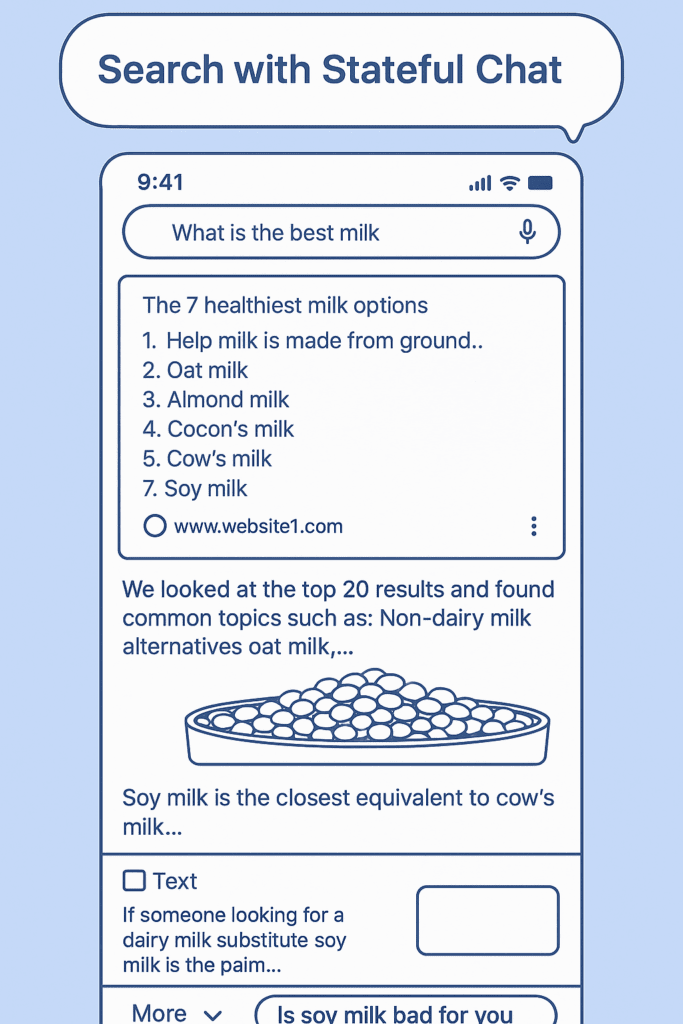
Search with stateful chat within the “Generative summaries for search results” patent (US11769017B1)
1. Retrieval-Augmented Generation (RAG) Backbone
At the core of AI Overviews is a system inspired by Retrieval-Augmented Generation. Google’s models don’t rely solely on pre-trained data. Instead, they dynamically retrieve relevant passages from the web at query time.
This ensures that the output (or answer) isn’t model hallucination—it’s grounded in real-time content indexed from trusted sources.
2. Passage Ranking and Semantic Relevance
Google’s passage-ranking models evaluate not just documents but specific sections of those documents to determine the most semantically relevant content. This fine-tuned approach ensures that the information included in AI Overviews is topically precise and aligned with searcher intent—especially critical for long-tail or complex queries (questions).
3. Dynamic Grounding with Web Sources
To prevent hallucinated or outdated responses, Google’s system “grounds” its generated summaries in high-confidence, web-based information. This involves validating facts across multiple sources and using document authority signals to determine trustworthiness, similar to how Google assesses pages for ranking in traditional SERPs.
4. Query Fan-Out for Complex Searches
AI Mode introduces a more advanced method called “query fan-out,” which breaks down particularly long or complex search queries into multiple sub-queries. This allows the retrieval engine to surface more diverse yet tightly relevant results—feeding these into the LLM to build a richer, multi-faceted summary tailored to layered user intents.
Method seen in the “Systems and methods for prompt-based query generation for diverse retrieval” patent (WO2024064249A1).
Summary
Gemini’s generative capabilities don’t operate in isolation. Instead, Google uses a process called grounding, which integrates live search results directly into AI-generated summaries. Before producing a response, Gemini runs a prediction score to decide whether to pull real-time data from the search index based on three factors:
- Relevance to the query
- Latency of retrieving the data
- Cost-efficiency of generation
This means that if your page is semantically relevant, topically authoritative, and optimized for informational search intent, it’s more likely to be retrieved and used as grounding data for AI Overviews.
To appear in the content Gemini pulls for grounding, your pages must:
- Use topical entities and relationships that match how Google understands a subject
- Answer questions clearly using structured, scannable content
- Align with searcher intent, especially for nuanced or multi-layered queries
If your content lacks these signals, it’s less likely to be surfaced—even if it ranks well organically—because dynamic retrieval depends on more than just keyword matching.
What Changes or Stays the Same for ChatGPT and AIO SEO
AI-driven search experiences like ChatGPT and Google’s AI Overviews/AI Mode are transforming how content gets surfaced—but they haven’t made traditional SEO obsolete. Instead, they’re raising the standards. Here are five key truths for SEO in an AI-first environment.
National SEO Approaches
While the landscape is shifting quickly and patents being filed regularly, it will be hard to exactly predict what the future looks like. For example, US20250036621A1 titled “Generating query answers from a user’s history” could indicate a number of potential outcomes (like high-personalization and AIO combinations), however, it would appear there are still some foundational aspects we should pay close attention to as these are improvements on top of a core system.
1. Topical Authority Still Wins
- Authoritative domains are more likely to be selected as grounding sources in ChatGPT and AI Overviews
- Trust signals—like topical depth and brand recognition—still matter
- Content from well-established sources is disproportionately favored by AI systems
What to do: Build deep, interlinked content hubs that signal topical expertise and entity relevance across your domain.
2. Semantic Relevance Is a Baseline Requirement
- AI systems assess content based on meaning, not just keyword matching
- Pages that are too loosely connected to a query are excluded from retrieval
- Search intent alignment remains critical
What to do: Optimize each page to align with specific questions or themes. Use entity-rich language and clarify the purpose of each section.
3. Passage-Level Optimization Is Now Essential
- AI Overviews extract and summarize specific content passages
- Weak or unfocused sections of a page will be ignored, even if the page ranks overall
- Formatting and clarity impact inclusion
What to do: Make every paragraph count. Use clear headings, tight sections, and direct answers to commonly searched questions.
4. Informational Content Has Renewed Importance
- AI Overviews rely heavily on blogs, guides, and tutorials to generate responses
- Informational content supports grounding and improves recall across related topics
- Shallow content is less likely to be retrieved
What to do: Invest in high-quality informational content. Ensure it’s comprehensive, up to date, and strategically positioned within your site’s architecture.
5. Trust and Accuracy Influence Inclusion
- Gemini and ChatGPT favor content that appears accurate and well-sourced
- Even if users don’t click through, your brand may be quoted or summarized
- Sites seen as untrustworthy or outdated are deprioritized
What to do: Maintain clear authorship, include citations where appropriate, and regularly audit your content for factual accuracy and freshness.
Local SEO Approaches
While the complete impact of how AI Mode and ChatGPT will impact local queries or local demand is still unknown. A white paper published by Local Falcon on May 21st, 2025 gives us some clues into what we can predict and do to prepare.
1. Proximity Still Matters—However, Less Than Before
- In traditional local packs, businesses closer to the searcher often rank higher.
- In AI Overviews, ranking position is no longer tightly correlated with distance.
- While businesses slightly closer to the searcher may appear more often, their position in AI results is driven by other factors.
What to do: Don’t rely on physical proximity alone. Focus on content that reinforces relevance to local services, even for searchers who aren’t immediately nearby.
2. Content Authority Trumps Location
- GAIO uses semantic understanding and content authority to determine inclusion and ranking.
- Businesses with strong informational content about services and customer needs are prioritized over nearby but under-optimized competitors.
What to do: Create in-depth, authoritative pages on your services, using language that aligns with how customers ask questions. Add FAQs, comparisons, and process explanations to boost topical coverage.
3. Business Category Impacts GAIO Ranking Stability
- Categories like insurance brokers and mobile phone stores have more stable AIO rankings across searcher locations.
- Others, such as attorneys or home services, experience more ranking volatility, depending on user location and phrasing.
What to do: If you’re in a volatile category, expand your coverage. Create content that targets a variety of query intents and scenarios, not just local keywords. Monitor visibility across neighborhoods or zip codes.
4. Longer, Informational Queries Trigger More AIO
- Queries over 60 characters—especially ones framed as questions—are far more likely to trigger AI Overviews.
- Short or commercial-intent queries more often return traditional results (as of May 2025).
What to do: Optimize for long-tail, service-focused questions like “how much does window cleaning cost” or “best pest control for apartment buildings.” Use natural language in headings and subheadings.
ChatGPT & AI Mode SEO Optimization Checklist
Use this checklist to guide your SEO strategy across both national and local search contexts in the evolving landscape of AI-powered search.
Core SEO Principles for ChatGPT and AI Mode Checklist
Retrieval-Augmented Generation (RAG) Awareness
- Understand that Google and ChatGPT retrieve live content to generate responses
- Ensure your pages are eligible for retrieval by maintaining indexing, crawlability, and clarity
- Avoid relying on outdated or thin content that cannot be dynamically grounded
National SEO Strategy Checklist
1. Build Topical Authority
- Develop deep content hubs around key service areas or themes
- Use internal linking to connect related content and reinforce expertise
- Align with known entity relationships and Google’s understanding of your domain
2. Optimize for Semantic Relevance
- Use entity-rich language and synonyms that reflect how users phrase questions
- Ensure content answers real questions—not just keyword-stuffed headlines
- Align every page with a clear query intent (informational, instructional, etc.)
3. Perform Passage-Level Optimization
- Break content into structured sections with H2s and H3s
- Include concise answers within each passage for better retrieval
- Use bullet points, tables, or clear formatting to aid LLM parsing
4. Create Rich Informational Content
- Develop how-tos, comparisons, definitions, and FAQs
- Update old blog content to reflect current best practices and industry terms
- Add visual or structured content (e.g., charts, reviews, process breakdowns)
5. Demonstrate Trust and Accuracy
- Add clear authorship, sourcing, and citations
- Regularly review and refresh outdated facts or content
- Ensure legal, financial, or medical content reflects real-world expertise
Local SEO Strategy Checklist (GAIO-Specific)
1. Don’t Rely Solely on Proximity
- Expand visibility by targeting service intent, not just location
- Mention multiple neighborhoods or service areas where applicable
- Emphasize what you do, not just where you are
2. Strengthen Content Authority Locally
- Create pages that explain your services in-depth
- Include FAQs that reflect local customer questions
- Add trust signals like testimonials, certifications, and service guarantees
3. Tailor the Strategy to Your Business Category
- Identify if your industry has volatile or stable GAIO behavior
- For volatile categories, publish more content for different intents and nearby areas
4. Target Longer, Informational Queries
- Optimize for 60–100+ character queries framed as natural questions
- Use headings like: “How much does ___ cost?” or “Best ___ near me for families”
- Anticipate user needs and offer service details, comparisons, and expectations
5. Balance Queries With and Without Location Names
- Target both location-specific and generic service queries
- Create “Best [Service]” content that performs well without needing a city in the query
- Track GAIO appearance rates by query type to inform future content planning
Sources
Search News Straight To Your Inbox
*Required