

Hot Sphinx Positions Itself as a Privacy-First Alternative in Online Shopping
Hot Sphinx has stepped into the crowded shopping search market with a bold promise: unbiased results, no invasive tracking, and fair exposure for both small merchants and household names. While giants like Amazon and Google lean on paid placement, Hot Sphinx wants to convince buyers and sellers that relevance alone should dictate what rises to the top. The platform is betting that consumers are ready for a new kind of search experience—one that emphasizes trust, fairness, and privacy over advertising dollars.
How Hot Sphinx Works
Most shoppers today accept that “top results” usually mean “highest bidder.” Hot Sphinx rejects that premise. Instead, it places millions of products from independent shops and global retailers on equal footing. Search queries are matched against relevance, not ad spend. For the average user, this means a search for “running shoes” could return both a handmade pair from a boutique cobbler and a model from a global sportswear brand, presented side by side without bias.
Its business model also separates it from mainstream competitors. Hot Sphinx only charges sellers when a sale is made through a partner site. That pay-per-sale approach is far less risky for small shops that can’t afford to gamble on pay-per-click campaigns. For larger retailers, it ties marketing spend directly to conversions, forcing accountability and efficiency. In both cases, the structure removes wasted spend and rewards performance instead of persistence.
It’s a straightforward concept: sellers succeed when buyers buy, not when buyers click without converting. This subtle but important difference makes Hot Sphinx attractive to merchants who are tired of spending heavily on ads that generate impressions but no revenue.
Privacy as a Selling Point
Shopping online has long come with strings attached: data collection, retargeting ads, and relentless profiling. Hot Sphinx sets itself apart by refusing to track users across the web. The absence of ads cluttering results also makes the search environment feel cleaner, less noisy, and more trustworthy. For consumers who are weary of being chased by the same product across multiple platforms, the privacy-first stance carries weight.
Beyond optics, privacy translates to peace of mind. Shoppers know that their search for a gift won’t follow them into unrelated sites for weeks. And sellers benefit too, as buyers associate Hot Sphinx with transparency and relevance rather than manipulation. In a market where trust is currency, privacy becomes more than a feature—it’s a brand identity.
This emphasis on privacy also positions Hot Sphinx well for regulatory trends. Governments in both the U.S. and Europe are pushing harder on data protection, with proposals that would restrict tracking practices. By building a model that sidesteps those practices entirely, Hot Sphinx may find itself ahead of the compliance curve.
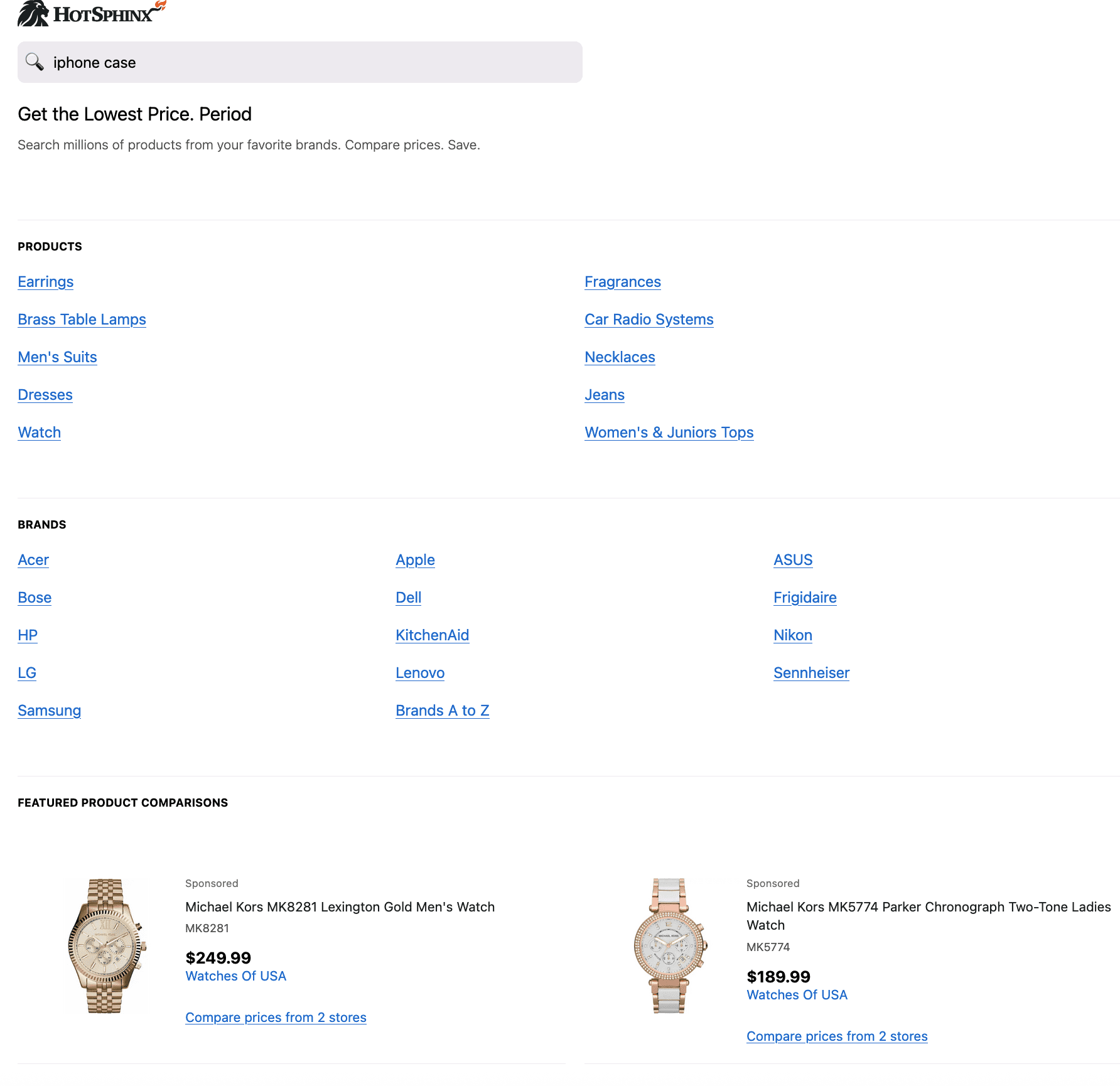
A view of the Hot Sphinx home page.
Leveling the Playing Field for Sellers
Small sellers have long struggled to compete against global retailers with deep ad budgets. Hot Sphinx promises to fix that imbalance. Instead of burying independent shops beneath a wall of sponsored placements, it puts them side by side with the biggest players. That exposure can be the difference between obscurity and discovery for niche categories such as handcrafted jewelry, rare collectibles, or artisan foods.
For larger retailers, the model enforces discipline. They can no longer rely on sheer ad volume to dominate results. Instead, their listings must stand on product quality and relevance. In practice, this makes Hot Sphinx a marketplace where innovation, creativity, and product differentiation are rewarded more than ad dollars.
That shift is significant. It signals a rebalancing of retail discovery where smaller brands can get noticed and large ones are forced to compete on the same stage. The risk is that sellers used to the pay-to-win system may resist. The reward is a healthier, more diverse marketplace for both sides.
How Hot Sphinx Compares to Amazon, Google, and Etsy
Amazon
Amazon remains the default for millions of shoppers, but its rankings are dominated by paid placements and private-label promotions. For users, this creates a constant question: are results here because they’re best, or because Amazon profits more from them? Hot Sphinx flips the equation. It removes paid bias entirely, offering results that reflect relevance alone. The tradeoff is convenience: Amazon still has unmatched logistics, Prime benefits, and one-click checkout, which Hot Sphinx cannot replicate.
Google Shopping
Google Shopping is a powerful aggregator, but access is dictated by ad spend. Smaller sellers often find themselves priced out of visibility. Hot Sphinx eliminates bidding wars altogether. A boutique fragrance maker can surface alongside a global brand without needing to outspend them. For buyers, that creates a broader and more authentic mix of results. For sellers, it strips away the anxiety of endless ad auctions.
Etsy
Etsy carved out a niche as a hub for independent creators. But even Etsy’s search results have tilted toward internal ads and promoted listings. Hot Sphinx broadens the concept by blending independent sellers with mainstream retailers in a single unbiased feed. A shopper can see a handcrafted ceramic vase from a local artisan displayed alongside a product from a multinational home goods company. That cross-category visibility is unique, and it challenges the segmented nature of existing marketplaces.
Industry Context
The broader shopping ecosystem has trained users to accept ads as part of the experience. But consumer fatigue is growing. Research consistently shows rising skepticism toward “sponsored” results. At the same time, privacy-first services such as DuckDuckGo in web search and ProtonMail in email have proven that alternatives can attract loyal followings by focusing on transparency and fairness.
Hot Sphinx is applying those lessons to commerce. Whether it can win meaningful share against entrenched giants is uncertain, but its differentiators are clear. If it builds scale, it could become the go-to destination for users tired of the constant upsell embedded in traditional platforms.
Possible Hurdles Ahead
Consumer Adoption
Habits are hard to break. Amazon and Google are embedded in daily life with saved cards, loyalty perks, and instant checkout. For Hot Sphinx to succeed, it must convince users that unbiased results and privacy outweigh the convenience of existing ecosystems. Building that case will require consistent messaging, strong user experience, and proof that its search results deliver quality and breadth.
Scale of Inventory
Competing with Amazon’s hundreds of millions of listings is no small feat. Hot Sphinx must scale its index to remain useful for both everyday and niche searches. Limited coverage would undermine its relevance. Growth depends on partnerships with both independent sellers and major retailers willing to embrace its pay-per-sale model.
Trust and Brand Awareness
Being privacy-first is a strong talking point, but shoppers will need reassurance that Hot Sphinx is reliable and secure. Building trust takes time and visible proof. Transparency in ranking, strong communication about data practices, and visible partnerships will be critical for credibility. Without that, adoption may stall.
Monetization Balance
The pay-per-sale model is attractive to sellers, but it raises questions about sustainability for the platform. If Hot Sphinx is too strict on its no-ads stance, revenue may lag behind expenses. If it relaxes its promise, it risks alienating its base. Striking the right balance between revenue and integrity will be a constant challenge.
A Forward-Looking Angle
Looking ahead, Hot Sphinx’s model intersects with larger industry shifts. AI-driven discovery is reshaping how people find products online. Platforms are experimenting with generative search results that summarize options rather than list them. Hot Sphinx’s relevance-first model could blend with AI by surfacing diverse, unbiased inputs into those summaries—offering users more trustworthy recommendations.
Regulatory trends also favor its position. New laws targeting transparency in search results and limitations on data tracking may erode the advantage of ad-heavy incumbents. By building a structure that doesn’t depend on those tactics, Hot Sphinx may find itself aligned with the future regulatory environment rather than scrambling to comply later.
And then there’s consumer sentiment. Buyers increasingly care about fairness, privacy, and authenticity. If Hot Sphinx can translate those values into a reliable, everyday tool, it may capture a segment of the market that feels underserved by today’s ad-dominated platforms. The question isn’t whether people want alternatives—it’s whether Hot Sphinx can stay relevant long enough to become one.
Availability
Hot Sphinx is available now at hotsphinx.com on both desktop and mobile browsers. The company is actively onboarding sellers and broadening product coverage, signaling that scale is a top priority in its early stages.
Hot Sphinx is placing its bet on fairness, relevance, and privacy in a market that has been shaped by ad spend for more than a decade. Its value proposition is clear: small sellers get equal exposure, buyers get unbiased results, and everyone avoids intrusive tracking. The hurdles—scale, awareness, and habit—are significant. But if the company can deliver breadth without sacrificing its mission, it has a chance to become more than a niche player. In an era defined by mistrust of ads and data collection, that chance may be enough to win an audience hungry for change.